
How to Apply for a Canada eTA in 2026: A Smarter Guide for Digital Travel Approval
A Canada eTA can look simple until a passport mismatch, eligibility mistake, or last-minute airport issue derails your trip. This guide explains who should apply, how the process works, what travellers often get wrong, and how to prepare with more confidence.
 Shadrach Oloyede19 min read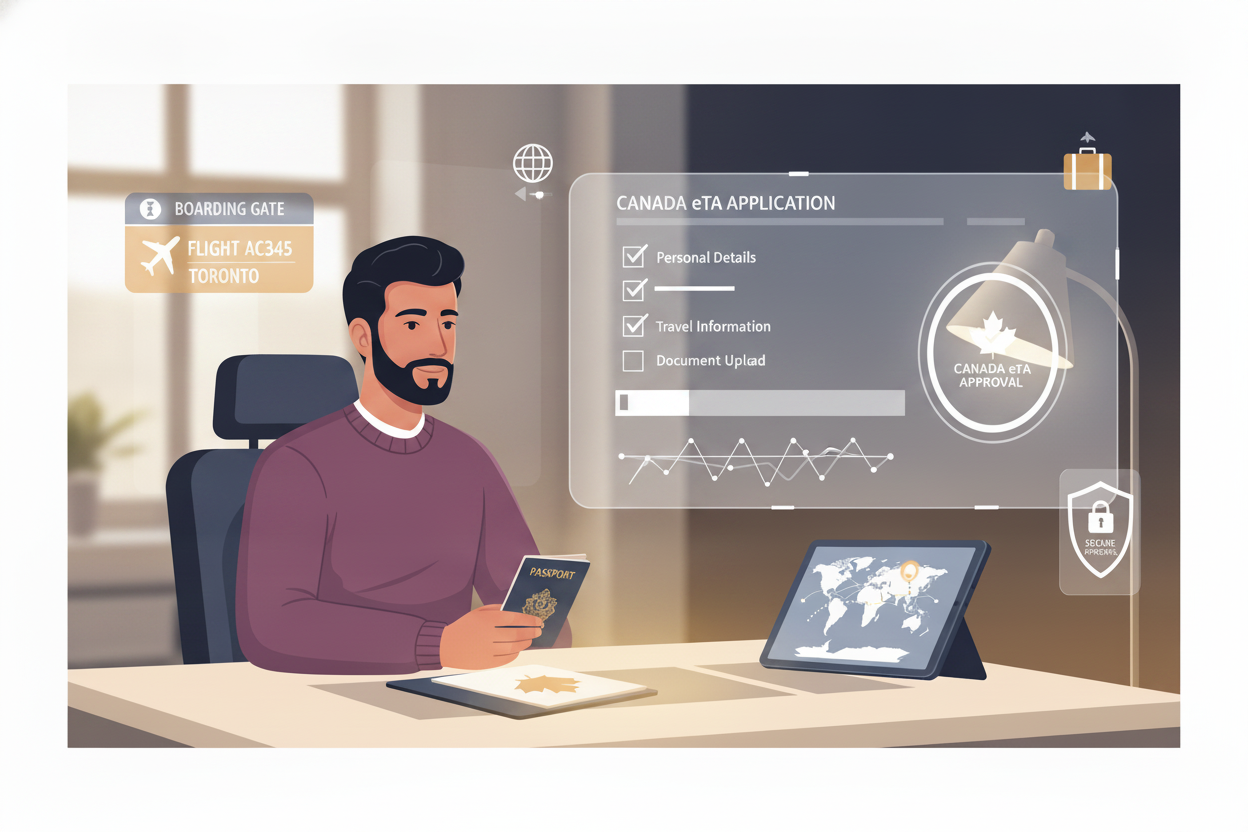
Why Canada’s eTA matters more than travellers expect in 2026
A traveller reaches the gate for a flight to Toronto, boarding pass in hand, hotel booked, meeting scheduled, bags checked. Then the airline agent says the problem is not the ticket. It is the travel authorization tied to the passport. Maybe the traveller applied with an old passport. Maybe they assumed a previous authorization still carried over. Maybe they never realized that an online approval system can still become a hard stop at check-in.That is why the Canada eTA deserves more publicity than it usually gets. It is digital, relatively quick to apply for, and easy to describe as “just one more online form.” But for many air travellers to Canada, it is one of the first document checks that can determine whether the trip begins smoothly or falls apart before boarding. The consequences are practical, not abstract: missed flights, rebooking costs, delayed study plans, disrupted family visits, and stressful airport conversations.
This guide is not only a step-by-step walkthrough. It is a response to a larger reality: digital entry systems can feel deceptively simple while still demanding strict accuracy. Eligibility rules, passport-linking, identity consistency, and document readiness all matter. For tourists, business visitors, students, and skilled workers, the safest approach is not speed. It is clarity.
LiveMigrate’s role in that journey is not to create more noise around immigration and travel admin. It is to make the process easier to understand in one place, so travellers can prepare carefully, reduce avoidable mistakes, and move forward with more confidence.
Key takeaway
Treat a Canada eTA as part of your real travel readiness, not as a minor online task to leave until the last minute.What a Canada eTA is, what it is not, and why people get confused
A Canada eTA, or Electronic Travel Authorization, is a digital travel authorization linked to a passport. It is generally relevant to many visa-exempt foreign nationals travelling to Canada by air. It is not a visitor visa, and it is not a guarantee of entry. Its function is narrower but still critical: it helps determine whether you can board a flight to Canada and present yourself for examination on arrival.The confusion starts because travellers often think in destination terms, not document-pathway terms. They ask, “I’m going to Canada, what do I need?” But the better question is, “Given my nationality, passport, and mode of travel, what document applies to me?” That distinction matters because the answer can change depending on whether you are flying, entering by land, transiting, renewing a passport, or travelling under a different immigration status than on your last trip.
Many people also assume that because the eTA is electronic, it behaves like a reusable account setting that follows them automatically. It does not work that way. The details in the application are identity-critical, and the authorization is tied to the passport used in the application. Change the passport, and your travel setup may also change.
A simple framework to understand the eTA
| Situation | What to check first |
|---|---|
| You are from a visa-exempt country and flying to Canada | Whether an eTA is required for your air travel |
| You may need a visitor visa instead | Whether you are on the correct document path |
| You are entering by land or sea | Whether eTA rules apply to that travel mode |
| You renewed your passport after a previous approval | Whether your prior authorization still matches your current document |
| You are transiting through a Canadian airport | Whether transit still requires the same travel authorization checks |
Why this catches travellers off guard
- “Canada entry” is not one universal process for everyone
- Travel mode can matter as much as nationality
- Passport changes can affect your authorization setup
- Prior approvals do not automatically answer current eligibility questions
- Advice from a friend with a different passport or status may be irrelevant
Who should double-check especially early
- Dual nationals
- Travellers with recently renewed passports
- Students returning for a new term
- Skilled workers travelling between assignments or permit updates
- Parents applying for children
- Business travellers booking on tight timelines
Key takeaway
The biggest early mistake is assuming the eTA is a generic Canada travel requirement rather than a passport-specific air travel authorization.Before you apply: the document prep that prevents most avoidable mistakes
The fastest way to create an eTA problem is to start the application before confirming that you are ready to apply. Most preventable errors happen in the prep stage: using the wrong passport, typing from memory, relying on saved profile data from an airline site, or misunderstanding whether the eTA is the correct document in the first place.A careful application starts offline. Put the passport you will actually travel with in front of you. Confirm that it is valid and that the personal details are clear and current. Decide which email address you will monitor. Prepare your payment method. If you are applying for a spouse, parent, or child, do not rely on what you think their details are. Read directly from the passport.
Travellers often underestimate how much friction comes from tiny data mismatches. A missing middle name, a transposed number, a wrong expiry date, or a mistaken country field can create stress that only becomes visible when check-in systems or airline staff compare your travel document with your authorization record.
Your pre-application checklist
Before you open the application, prepare:- The valid passport you will use for the trip
- Personal details exactly as shown on that passport
- A reliable email address you check regularly
- An accepted payment method
- A clear travel purpose, such as tourism, family visit, business visit, study-related return, or transit
- Any prior travel or immigration details you may need to answer accurately
Accuracy checks worth doing twice
Verify these directly against the passport:- Full name order and spelling
- Passport number
- Passport issue date
- Passport expiry date
- Date of birth
- Country of citizenship
- Any punctuation, multiple surnames, or middle names shown in the document
Timing habits that reduce stress
A smart traveller does not wait until airport week to sort this out. Even if a digital system is designed to be simple, your wider trip may depend on a clean authorization record before you finalize other plans.Good habits include:
- Applying with enough time to notice and fix issues if they arise
- Checking your document setup before buying non-refundable extras
- Reviewing all travellers’ documents separately for family trips
- Rechecking travel authorization after any passport renewal
Key takeaway
Most eTA problems do not begin with rejection. They begin with rushed preparation and incorrect passport-linked details.How the Canada eTA application process works step by step
The eTA process is completed online, but “online” should not be mistaken for “automatic” or “risk-free.” A short digital form can still carry outsized consequences because every field is part of how your travel identity is assessed. The form is simple only when your preparation is solid.The first principle is to use the official government pathway rather than a site that looks official but adds service fees or introduces extra confusion. Third-party sites are one reason travellers feel uncertain: the process is already sensitive, and unnecessary intermediaries can make it harder to understand what you are paying for or what stage your application is actually at.
Once you are in the application, slow down. Answer each question honestly, and make sure your answers are consistent with your passport and travel context. If you are disclosing prior travel, identity, or immigration information, do not guess. If you are not sure what a question is asking, pause before submitting rather than rushing through because the form looks short.
After submission, your job is not over. Watch the email address you used, including spam and promotions folders. Keep your confirmation and any reference details somewhere easy to access. If you are travelling on a deadline, having your records organized can save time and anxiety.
Step-by-step application flow
1. Confirm that an eTA is the correct travel document for your situation 2. Gather your passport, email address, and payment method 3. Start the online application through the official channel 4. Enter personal and passport details exactly as shown on the document 5. Complete the required questions carefully and honestly 6. Review all fields before payment and submission 7. Submit the application 8. Monitor your email for updates or follow-up messages 9. Save confirmation details with your travel records 10. Recheck your document alignment before departureWhat deserves special attention on the form
- Whether you are applying for yourself or another traveller
- Whether names appear differently than in old bookings or profiles
- Whether your current passport is the same one you will present at check-in
- Whether your email address has been typed correctly
- Whether your answers are consistent with the real purpose of your trip
A practical example
Imagine a student returning to Canada after a semester break. They previously travelled on one passport, then renewed it before booking the next flight. They assume the old authorization still covers the new document and do not check carefully. Everything looks fine until airline document verification flags the mismatch. The problem is not that the system is unpredictable. The problem is that digital travel approvals are document-specific, and travellers often overlook that.Key takeaway
The safest way to complete the eTA application is to treat it like identity verification, not like a casual booking form.The mistakes that cause the most airport stress
Most eTA-related travel problems are surprisingly ordinary. They are not dramatic immigration cases. They are admin errors that become expensive at the worst possible moment: wrong passport number, wrong passport altogether, misunderstood eligibility, ignored email follow-up, or assumptions about a prior approval still being valid.What makes these mistakes serious is timing. A typo made at the kitchen table can remain invisible until online check-in, bag drop, or the boarding gate. By then, the options are narrower, emotions are higher, and every correction can affect flights, hotels, work schedules, or school start dates.
Families and group travellers are especially vulnerable because one mistaken assumption can spread across multiple bookings. Parents may assume one application covers everyone. Travellers may copy the same data pattern across family forms without checking each passport individually. Group urgency often creates the exact conditions where careful review gets skipped.

Common mistakes travellers make
- Typing errors in passport number or passport dates
- Applying with one passport and travelling with another
- Assuming an old authorization still applies after passport renewal
- Using a third-party site without realizing it adds extra fees or confusion
- Confusing an eTA with a visitor visa requirement
- Failing to monitor the email inbox used in the application
- Leaving the process too close to departure
- Assuming a child or spouse is covered by another person’s application
How these errors usually show up in real life
| Mistake | When it often becomes visible | Why it matters |
|---|---|---|
| Wrong passport number | Check-in or airline verification | Authorization may not match the travel document |
| Old passport used in application | Before boarding or document review | eTA is linked to the original passport details |
| Wrong document type assumed | Before application or before travel | Traveller may need a visa, not an eTA |
| Missed email follow-up | Days later or close to travel | You may miss requests or status information |
| Family member not separately checked | Group departure day | One traveller’s issue can disrupt the whole itinerary |
A quick self-audit before your flight
Ask yourself:- Is the eTA linked to the same passport in my carry-on?
- Have I renewed or changed passports since any previous approval?
- Am I certain an eTA, not another document, applies to me?
- Have I checked the inbox used for the application recently?
- Does every person in my group have their own correct document setup?
Key takeaway
The most costly eTA mistakes are usually small, preventable, and discovered too late.Travel day and arrival: what an approved eTA does and does not do
An approved eTA helps many travellers board a flight to Canada. That is important, but it is not the same as guaranteed entry. This is where a lot of confusion persists. Travellers sometimes think approval means the document stage is finished and the rest is routine. In practice, the eTA solves one important part of the journey, not every part of admissibility and arrival.On travel day, airlines typically focus on whether your passport appears to have the required travel authorization attached to it for air travel. On arrival, border authorities can still examine your identity, purpose of travel, and supporting documents. That means your preparation should extend beyond the authorization itself.
A tourist should be ready to explain the visit simply and consistently. A business traveller may want meeting details accessible. A student or worker returning to Canada should have relevant status-related documents organized. The goal is not to carry a suitcase full of paperwork. It is to have the right documents available, easy to present, and consistent with the story of your trip.
What to keep easy to access
- The passport used for the eTA application
- Your flight itinerary
- Where you will stay in Canada
- Return or onward travel details, where relevant
- Contact details for a host, school, employer, or meeting point if applicable
- Any study- or work-related documents relevant to your status or return travel
Travel stages at a glance
| Travel stage | What usually matters most |
|---|---|
| Airline check-in | Passport identity and travel authorization match |
| Boarding gate | Same passport, same traveler, same document setup |
| Arrival in Canada | Purpose of trip, identity, admissibility, supporting context |
Smart habits on arrival
- Answer questions clearly and truthfully
- Keep key documents in your carry-on, not checked luggage
- Make sure your stated purpose matches your actual plans
- Avoid vague answers if your trip has a clear purpose such as study, family visit, or business meetings
Key takeaway
An approved eTA is necessary for many air travellers, but it is only one part of being fully prepared to enter Canada.What most people get wrong about digital entry systems
Here is the contrarian truth: digital travel systems do not necessarily make travel simpler. They often make travel feel simpler. That is different. The interface may be clean, the form may be short, and the authorization may be described in quick, reassuring language. But beneath that convenience sits a strict logic: eligibility rules still matter, passport identity still matters, and human review still matters.This is why experienced travellers can still get caught out. Confidence is not the same as compliance. Someone who has flown internationally many times may assume they can breeze through another authorization because previous trips went smoothly. But digital entry systems are only as accurate as the information entered, and they do not forgive assumptions about nationality rules, passport changes, or mixed travel purposes.
This matters especially for travellers whose situations are not perfectly neat. Dual citizens, people with previous refusals, students changing schools, workers with updated permits, or travellers combining tourism with another purpose often need more thought than a basic “fill the form and go” mindset allows. The smartest move in a complex case is often to slow down and review the whole travel picture.
LiveMigrate is useful in exactly this gap. Not as hype, and not as a substitute for official rules, but as practical infrastructure for understanding what applies to your case, organizing travel steps, and reducing avoidable errors before you submit.
Situations where self-service needs extra caution
- You hold more than one nationality or passport
- You recently changed your name or passport
- You have old records under different personal details
- Your trip combines tourism with business, school, or family obligations
- You are unsure whether an eTA is the right document at all
- You are relying on old travel experience rather than current document checks
Better questions to ask before applying
Instead of asking only, “How fast can I do this?” ask:- Am I definitely using the right travel document pathway?
- Are my passport details current and consistent everywhere?
- Does the purpose of my trip make sense and stay consistent across my documents?
- If someone asks me at check-in or arrival what this trip is for, can I explain it clearly?
Key takeaway
The hidden risk is not that the eTA system is too complicated. It is that travellers underestimate how exact digital travel systems still are.A practical action plan you can use before you book, apply, and fly
The best eTA applications are usually boring. The passport matches. The traveler knows which document they need. The application is reviewed carefully. The email is monitored. The travel purpose is clear. Nothing dramatic happens at the airport because the admin was handled properly beforehand.If you want a smoother experience, use a checklist-based workflow rather than relying on memory. This is especially important for families, international students, and skilled workers whose trips often involve more than one important document. Think of the eTA as part of your wider travel file, not as a one-off click.
Start by confirming your passport strategy. Which passport will you physically carry? Has anything changed since your last trip to Canada? Are your bookings and authorization details aligned? Then confirm your trip purpose in one plain sentence. If you cannot describe the reason for your trip simply, pause and sort that out before applying.
Finally, build a habit of storing confirmations and reviewing the whole package before departure. A calm document check a week before your flight is worth far more than a panicked one at the airport.

10-step action checklist
1. Confirm that an eTA is the correct document for your travel scenario 2. Choose the exact passport you will use for the trip 3. Check that passport details are clear, current, and copied accurately 4. Prepare a reliable email address and payment method 5. Complete the application slowly rather than quickly 6. Review all identity fields before paying and submitting 7. Save the confirmation and any reference details 8. Check your inbox after submission, including spam folders 9. Reconfirm your document setup before check-in and departure 10. Keep relevant supporting documents accessible for arrivalBest practices by traveller type
For tourists- Keep accommodation and onward plans handy
- Make sure your trip purpose is simple and consistent
- Keep meeting details and host contacts easy to access
- Avoid describing work activity vaguely if there is a clear business purpose
- Review passport renewals and travel documents before booking
- Carry school-related details relevant to your return travel
- Make sure passport details align with your current travel and work documents
- Keep employer, destination, or assignment details accessible where relevant
- Keep the host address and contact details available
- Review each family member’s document requirements separately
A useful pre-flight mini-routine
The day before online check-in, verify:- The passport in your bag is the same one used for your eTA
- Your travel itinerary still matches the purpose you declared
- Your key emails and confirmations are easy to find
- Every traveller in your party has their own correct documents
Key takeaway
A structured checklist is the simplest way to reduce uncertainty and avoid last-minute eTA problems.Conclusion
The Canada eTA process is manageable, but only if you treat it with the seriousness that digital entry systems deserve. The application itself may be short. The consequences of small mistakes are not. Most travel disruption happens because people assume an online authorization is informal, reusable in ways it is not, or disconnected from the rest of their travel documents.The smarter approach is simple: confirm the right pathway, prepare your passport details carefully, apply with accuracy, monitor your email, and recheck everything before departure. That is how you turn a potentially stressful digital requirement into a routine part of a well-prepared trip.
If you are planning a Canada visit, study journey, family trip, or work-related travel, LiveMigrate helps you organize the moving parts in one place so you can understand what applies, prepare more confidently, and reduce avoidable mistakes before you apply. Use this guide as your working checklist, then build your travel plan with the same care you would give your flight, booking, and arrival plans.
FAQ and conclusion: final answers before you apply
FAQ
Is a Canada eTA the same as a visa? No. An eTA is a travel authorization used for many visa-exempt travellers flying to Canada. It is different from a visitor visa.Do I need a separate eTA for each family member?
Each traveller is assessed individually. Do not assume one approval covers everyone in a family or group.
What if I get a new passport after applying?
Because the eTA is linked to the passport used in the application, a new passport can affect whether your previous authorization still works for travel. Recheck before you fly.
Does an approved eTA guarantee entry to Canada?
No. It can help authorize air travel to Canada, but border authorities still assess entry on arrival.
Canada eTA
Ready to travel to Canada?
Apply for your Canada Electronic Travel Authorization online. Quick, guided, and approved in minutes.