
Understanding eTA: Why Some Visa-Free Trips Still Require Authorization
Visa-free travel does not always mean paperwork-free. Learn when an eTA is required, how it differs from a visa or eVisa, and how to avoid costly boarding-day surprises.
 Shadrach Oloyede17 min read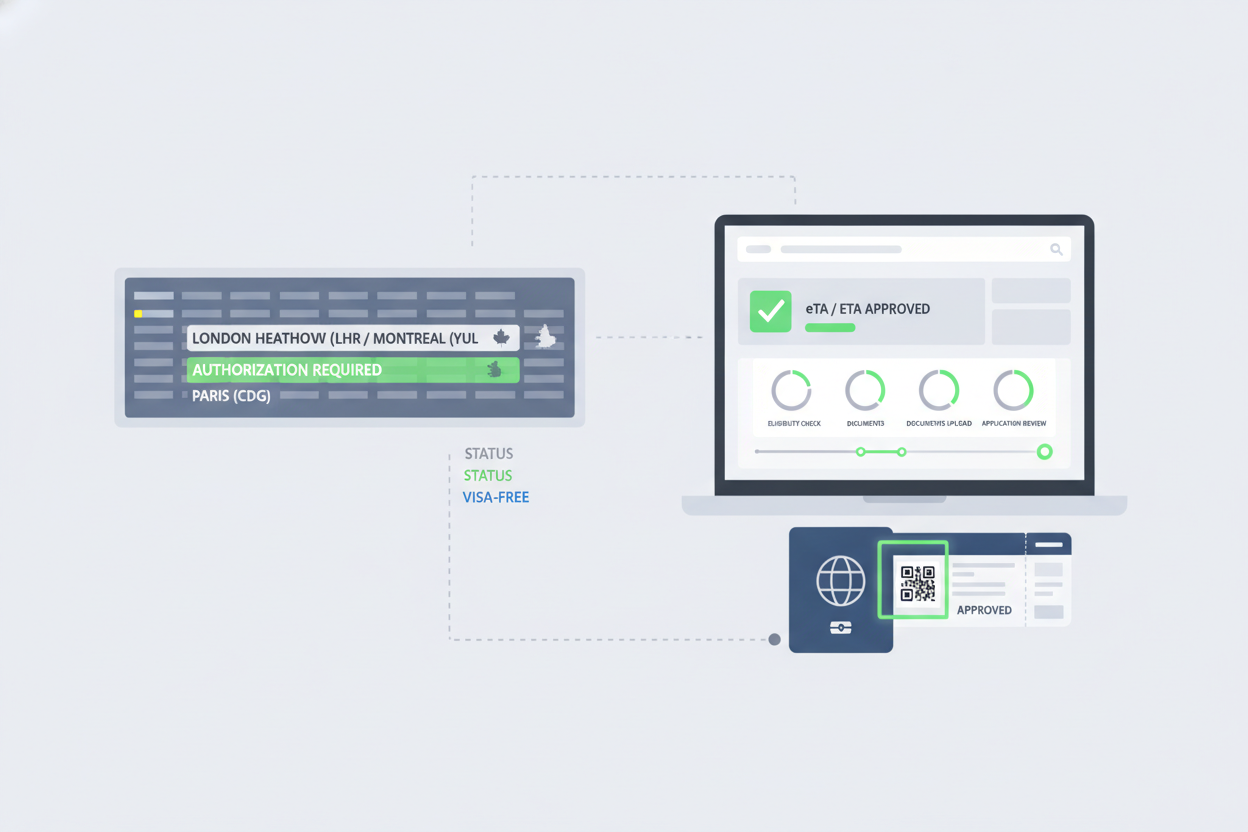
Why this matters before you book anything
You can have a valid passport, a paid flight, a hotel confirmation, and a clear travel plan — and still be stopped at check-in because one digital authorization is missing.
That is the practical reason eTAs matter now. For many travelers, the biggest misunderstanding in modern travel is assuming that visa-free means nothing to apply for. It often does not. In several systems, visa-free simply means you do not need a traditional visitor visa. You may still need a digital pre-travel approval before boarding, especially for air travel.
This catches people out because the trip looks simple on paper. A holiday, a family visit, a short business meeting, or even an airport connection can feel routine. But travel rules now sit across multiple layers: passport nationality, destination, transit stop, mode of travel, and trip purpose. If one layer is missed, the airline may flag the problem before you even reach border control.
For international students, skilled workers, and frequent flyers, this matters even more. Short trips often overlap with bigger migration plans: attending a university event, exploring a move, meeting an employer, visiting family before a study start date, or transiting through a country on the way to somewhere else. In those cases, assuming instead of checking can be expensive.
The simplest rule to remember is this: visa-free does not always mean authorization-free.
This guide explains what an eTA is, why countries use it, where travelers get confused, how it differs from a visa or eVisa, and how to build a smarter pre-travel process that reduces last-minute surprises.
What an eTA is and why governments use it
An Electronic Travel Authorization, often written as eTA or ETA, is a digital travel permission linked to your passport. It is commonly used for travelers who may be visa-exempt for short visits but still need pre-travel screening before they fly.
That makes an eTA different from both a full visa and from no requirement at all. It is lighter than a traditional visa process, but it is still a real travel document requirement where applicable. Canada’s official guidance explains that an eTA is electronically linked to the passport used in the application, and the UK’s official ETA guidance similarly states that eligible travelers need an ETA before travel.
Why countries introduced eTA systems
Governments use these systems for practical reasons, including:
- screening some travelers before departure
- helping airlines verify travel permission at check-in
- managing large passenger volumes through digital systems
- keeping visa-free access for eligible nationals while adding an extra security layer
What an eTA usually covers
In general, an eTA is designed for short-term visitor activity such as:
- tourism
- visiting family or friends
- some business visits, like meetings or conferences
- some transit journeys
- certain short courses or limited visitor-permitted activities
Official examples from the UK and Canada
According to the UK government’s ETA information, travelers who are eligible under that system need permission before travel to the UK. Supporting guidance for U.S. travelers from DoDEA reinforces that travelers should check the UK ETA requirement before departure.
Canada’s official eTA page states that some visa-exempt foreign nationals need an eTA to fly to or transit through a Canadian airport. That wording is important because it shows how the requirement can depend not just on who you are, but also how you travel.
The core confusion: why visa-free can still mean pre-travel paperwork
The phrase visa-free sounds simple. That is exactly why it causes problems.
Many travelers hear “you do not need a visa” and mentally translate it to “you only need your passport.” In older travel systems, that assumption was more often true. In today’s travel environment, it is often incomplete. A country can waive the need for a traditional visa while still requiring digital pre-authorization before boarding.
Where travelers misread the rules
The most common misunderstandings look like this:
- “I traveled there before, so the same rule still applies.”
- “My friend went last year with just a passport.”
- “I do not need a visa, so I do not need anything else.”
- “It is only a short transit, so no document is needed.”
- “The airline would tell me during booking if anything was missing.”
Visa-free is a category, not a guarantee of zero admin
Think of visa-free travel as a broad status, not a complete checklist. It may mean you are exempt from a traditional visitor visa, but it does not tell you whether the destination uses a separate digital authorization layer.
That is why “visa-free” and “eTA-required” are not contradictory. They sit in the same travel system. A traveler may be exempt from one type of approval and still required to hold another.
A practical example
A traveler going to the UK for a short holiday may not need a traditional visitor visa based on nationality. But under the UK ETA system, that same traveler may still need authorization before departure. Likewise, some visa-exempt travelers flying to or transiting through Canada still need an eTA under Canada’s official rules.
The key lesson is simple: visa exemption reduces paperwork compared with a traditional visa, but it does not always remove pre-travel compliance.
Why this matters financially
Missing an eTA can cause real costs, including:
- denied boarding
- missed onward flights
- hotel or tour losses
- rebooking fees
- urgent same-day stress with limited support options
How eTA rules work in real travel situations
The easiest way to understand an eTA is to stop thinking of it as abstract immigration language and start treating it as a route-and-purpose rule.
Whether you need one can depend on several variables at once, not just nationality.
The five checks that matter most
| Factor | Why it matters |
|---|---|
| Passport nationality | eTA systems apply only to certain nationalities or eligibility groups |
| Destination country | Each country sets its own authorization rules |
| Mode of travel | Some eTA requirements are specifically tied to air travel |
| Purpose of visit | Visitor travel is different from work, study, or settlement |
| Transit vs entry | Even a connection can trigger authorization in some cases |
Air travel can change the answer
One of the most overlooked points in this topic is that the answer can change depending on how you arrive. Canada’s official page is explicit that certain travelers need an eTA to fly to or transit through a Canadian airport. That means a traveler cannot safely assume that land, sea, and air are always treated the same way.
This is where people get caught. They may check a general destination rule but fail to notice that their specific route — especially a flight connection — triggers a different requirement.
Transit is not automatically document-free
Travelers often think transit should be easier because they do not intend to enter the country fully. In practice, transit rules can still require advance travel authorization.
A short airport stop does not always mean zero paperwork. If your itinerary includes a country that operates an ETA or eTA system, you need to verify whether your connection falls inside that scheme.
Use a route-based checking habit
A practical way to reduce mistakes is to review your trip in this order:
1. Which passport will you travel with?
2. Where is your final destination?
3. Are you transiting through another country?
4. Are you flying, driving, or arriving by sea?
5. Is your activity clearly visitor travel?
This is also where a planning tool like LiveMigrate can be genuinely useful. Instead of manually piecing together eligibility, route assumptions, and travel-document planning, travelers can use LiveMigrate to organize checks earlier and avoid missing an authorization layer until the last minute.

eTA vs eVisa vs traditional visa: the difference that actually matters
Travelers often search the wrong term and end up on the wrong process. That usually happens because eTA, ETA, eVisa, and visa are treated as if they mean the same thing. They do not.
The short version
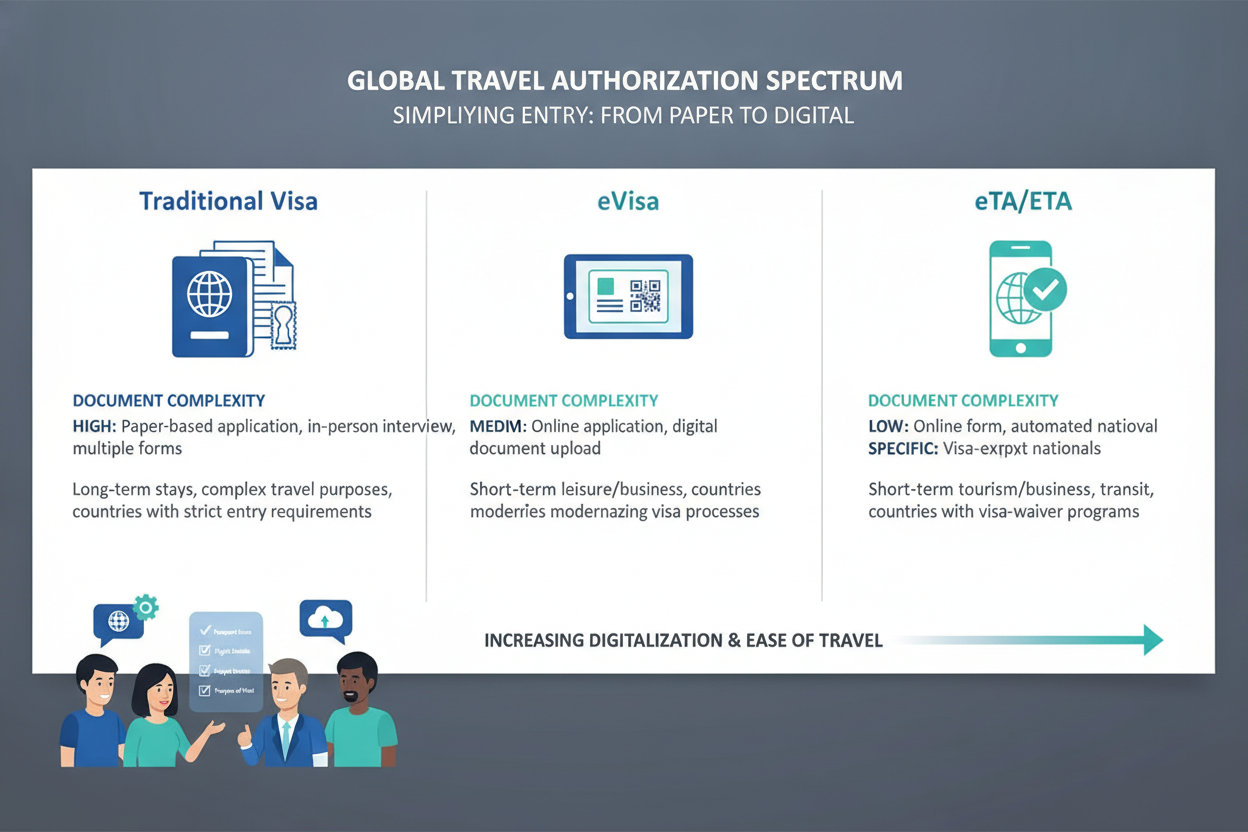
- Traditional visa: formal permission, often with more documents and deeper review
- eVisa: still a visa, but applied for or issued digitally
- eTA / ETA: a lighter pre-travel authorization, often for people who are otherwise visa-exempt
Comparison table
| Document type | Typical user | Usual process | Common use case |
|---|---|---|---|
| Traditional visa | Traveler not covered by visa exemption or needing a specific immigration category | May require supporting documents, appointments, biometrics, or interviews | tourism, work, study, family, long stays |
| eVisa | Traveler who still needs a visa but can complete the process online | Digital form, document uploads, and review | tourism or business where online visa issuance is available |
| eTA / ETA | Traveler who may be visa-exempt but still needs pre-clearance | Short digital application linked to passport | short visits, transit, tourism, some business travel |
Why using the wrong label causes problems
If you search “visa” when the country uses an ETA, you may overcomplicate the process. But the reverse problem is even worse: if you apply for an ETA when your purpose of travel actually requires a visa or permit, you may arrive with the wrong permission entirely.
For example, these are not always the same category:
- attending meetings vs starting paid work
- visiting a campus vs beginning a long study program
- exploring relocation options vs taking up residence
- attending a conference vs performing hands-on client work
A useful rule of thumb
If the trip looks short, limited, and visitor-like, an eTA may be the right lane.
If the trip involves employment, long study, residence, or a more formal immigration purpose, slow down and verify whether you actually need a visa or permit instead.
For skilled workers and students, this distinction matters a lot. A scouting trip, admissions visit, or pre-move family visit may fit visitor travel, but the actual work or study phase usually requires a different immigration route.
How to apply smarter and avoid preventable eTA mistakes
Most eTA applications are simpler than visa applications. That simplicity is useful — and deceptive.
Because the form is short, people rush it. But short forms are not harmless forms. A single wrong passport digit, date, or document choice can break the match between your authorization and the passport you present at check-in.
What you usually need before starting
Canada’s official eTA page says applicants generally need a passport, an email address, and a way to pay. The UK ETA process also follows a digital application path. Exact steps vary by country, but the preparation logic is similar.
Before you begin, have:
- the exact passport you will travel with
- a reliable email address you actively monitor
- an accepted payment method
- enough time to complete and review the form carefully
The five mistakes that cause the most trouble
1. Entering the wrong passport number
Even one incorrect character can create a mismatch.
2. Applying with the wrong passport
Dual nationals and people with recently renewed passports are especially vulnerable here.
3. Mixing up issue and expiry dates
This is common on mobile devices and when people complete forms in a hurry.
4. Assuming purpose does not matter
If your trip is not genuinely visitor travel, the eTA may not be the right permission.
5. Leaving it too late
Even when many applications move quickly, official systems do not promise identical timing in every case.
A safer application workflow
Use this sequence:
- confirm your route and purpose first
- prepare your passport before opening the form
- complete the application in one sitting if possible
- review all passport fields character by character
- save confirmation and approval details immediately
Where LiveMigrate fits in
If you want a more guided planning experience, LiveMigrate can help you check eligibility logic and organize the application process before submission. That is particularly helpful if you are also managing visas, permits, or travel for family members and do not want an eTA requirement to get buried under larger migration tasks.
What most people get wrong: an eTA is helpful, but it is narrow
Here is the part many travelers underestimate: eTAs feel easy, so people assume they are flexible. Usually, the opposite is true.
An eTA is often simple because it is designed for a narrow travel lane. It works well for ordinary short-term visitor travel. It is not a catch-all permission for any travel purpose that happens to be brief.
Approval does not guarantee entry
This is the most important nuance in the whole topic.
An approved eTA generally means you have met the pre-travel authorization requirement. It does not mean a border officer must admit you. Final entry decisions remain with border authorities.
That matters if your trip details are unclear or if your situation raises questions, such as:
- vague travel purpose
- inconsistent itinerary
- missing onward plans
- unclear accommodation arrangements
- previous immigration issues
Short trip does not always mean visitor trip
Modern travel patterns blur categories. A traveler may think:
- “I’m only working remotely.”
- “It’s just a short project.”
- “It’s unpaid, so it should count as visiting.”
- “I’m only attending training for a few days.”
That is why caution is needed for:
- remote work during an extended stay
- internships or placements
- practical or hands-on assignments
- paid events or performances
- structured study beyond ordinary visitor allowances
Passport changes are a hidden trap
Because eTAs are commonly linked to the passport used in the application, a renewed, replaced, lost, or stolen passport can affect whether the authorization still matches your travel document.
Travelers often remember the approval but forget the passport link. That is exactly the kind of small administrative detail that causes airport problems.
Rules can change quietly
Another contrarian point: prior travel success is weak evidence.
Just because you traveled on a route before does not mean the requirement is unchanged now. Systems evolve, nationality coverage expands, rollout phases change, and guidance updates. Rechecking before each trip is smarter than relying on memory.
A practical pre-travel system for students, workers, and frequent flyers
The safest approach is not “remember to apply.” It is building an eTA check into your normal travel workflow.
That matters most for people whose travel serves a bigger life move: students preparing for study abroad, professionals exploring work opportunities, and families managing multi-country trips. In those cases, travel-document mistakes are rarely isolated. One missed authorization can derail a whole chain of bookings and deadlines.
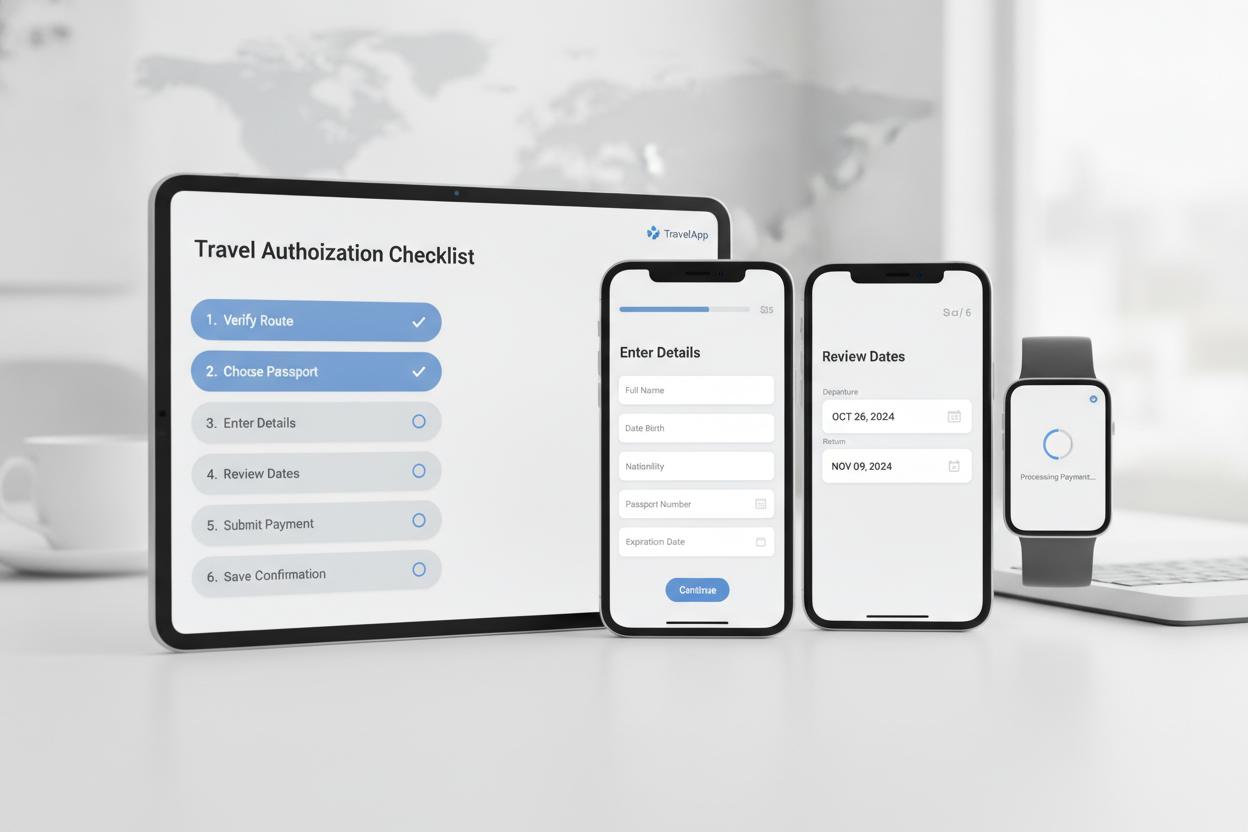
Your 7-step pre-travel checklist
1. Confirm the passport you will use
Do not start with assumptions. Start with the exact passport you will carry.
2. Check destination and transit requirements together
Review both the country you are visiting and any country where you change planes.
3. Match the route type
Ask whether the rule changes for air, land, or sea entry.
4. Match the real purpose of your trip
Tourism, family visits, meetings, study, and work are not interchangeable categories.
5. Apply early enough to absorb problems
Do not treat digital travel authorization like an airport kiosk step.
6. Save every confirmation
Keep:
- confirmation email
- approval notice
- reference number
- screenshot or PDF if available
7. Recheck after any passport change
A new passport is a new document reality. Never assume old approvals still map correctly.
A quick-use travel table
| Before travel | What to do |
|---|---|
| Booking stage | Check whether your nationality and route may require an eTA |
| After booking | Confirm transit rules and trip purpose alignment |
| Before applying | Use the exact passport you will carry |
| After approval | Save all records and keep them accessible |
| Before departure | Recheck passport validity and authorization status |
Best practice for migration-linked travelers
If your trip sits inside a wider immigration journey, treat the eTA as one part of a larger compliance file. That means keeping your passport, travel bookings, course or employer documents, and authorization records organized in one place.
This is another reason LiveMigrate can be valuable. Instead of handling your eTA as a disconnected errand, you can use a migration-focused platform to track eligibility, timelines, and application tasks in a way that fits real international moves.

FAQ: quick answers travelers actually need
Do I need an eTA if I do not need a visa?
Possibly. A traveler can be visa-exempt and still need an eTA or ETA before travel.
Is an eTA the same as an eVisa?
No. An eVisa is still a visa issued digitally. An eTA is usually a lighter pre-travel authorization for eligible visa-exempt travelers.
Can I sort out an eTA at the airport if I forget?
You should not rely on that. If your route requires an eTA, the airline may deny boarding before you travel.
Does an approved eTA guarantee entry?
No. It usually satisfies the pre-travel authorization step, but final admission is decided by border authorities.
Do children need their own authorization?
Often, each traveler is assessed individually. Check the applicable rules for minors before departure.
Do I need a new eTA after getting a new passport?
In many cases, yes, because the authorization is commonly linked to the passport used in the application.
Conclusion: treat eTA checks as part of real trip planning
The biggest takeaway is simple: a trip can be visa-free and still require preparation.
That is why travelers should stop thinking of eTAs as obscure technicalities and start treating them as standard travel planning. If your destination or transit country uses an ETA system, missing it can interrupt your journey before you even board. If your trip purpose falls outside ordinary visitor activity, the bigger risk is using the wrong type of permission entirely.
Before any international trip, especially one connected to study, work, or relocation planning, do three things:
- verify whether your passport and route require an eTA
- make sure your travel purpose matches visitor permissions
- apply early and keep your records organized
A five-minute check before departure can protect flights, bookings, and bigger life plans.
Canada eTA
Ready to travel to Canada?
Apply for your Canada Electronic Travel Authorization online. Quick, guided, and approved in minutes.
Browse by topic