What Is an Electronic Travel Authorization? What Travellers Need to Know in 2026
An electronic travel authorization can be the small digital approval that determines whether you board smoothly or get stopped at check-in. Here’s what eTAs and ETAs mean in 2026, who commonly needs one, and how to avoid the mistakes that derail trips.
 Shadrach Oloyede21 min read
Why electronic travel authorization matters more in 2026
Picture the moment: boarding pass in hand, bags checked, gate about to close — and the airline tells you that you can't fly. Not because of a missing visa. Not because of a passport that's about to expire. Because of a small digital form most travellers have never even heard of.
It happens more often than people expect, and the failure point rarely shows up at immigration. It starts earlier: at online check-in, at the airline desk, or the moment a passport is scanned against a digital travel record that doesn't match. For a growing number of journeys, that record is an electronic travel authorization — a small approval with an outsized effect on whether the trip begins at all.
That is why eTAs and ETAs matter more in 2026 than they did even a few years ago. More countries are using digital pre-travel screening. More journeys involve layered entry rules. And more travellers are crossing borders for short visits, study, remote work arrangements, family trips, or skilled migration pathways that involve multiple stops and multiple document types.
An electronic travel authorization is easy to underestimate, precisely because it looks so simple. The form is usually online, the process feels lightweight, and the acronym sounds interchangeable from one country to the next. But simple does not mean optional. If your authorization is missing, linked to the wrong passport, or mistaken for a visa substitute, the consequences can be immediate — and expensive.
For travellers in 2026, the bigger challenge is not just knowing what an eTA is. It's knowing how it fits into a more digital, more fragmented travel system. You may be visa-exempt for one destination, need an ETA for transit through another, and still need separate study, work, or family documents that the airline will expect you to have sorted before you board.
The key shift in 2026: travel compliance is increasingly digital, passport-linked, and checked before boarding — not only at the border.
This guide explains what an electronic travel authorization is, what it isn't, who should check carefully, how the process usually works, and how to build a cleaner travel-checking routine before you book and fly.
What an eTA or ETA actually is — and what it is not
An electronic travel authorization is a digital permission to travel, used by some countries for eligible travellers. You'll usually see it written as eTA or ETA, depending on the country. In most cases, it's designed for travellers who don't need a full visitor visa for a short stay, but who still must complete a pre-travel authorization step before boarding.
The most important operational detail is that an eTA or ETA is typically linked electronically to the passport used in the application. There may be no sticker, no paper label, and sometimes no visible travel document beyond a confirmation message. That can make travellers assume it's informal. It isn't. The authorization may be digital, but it remains an immigration-related requirement.
What an eTA or ETA usually covers
These authorizations are commonly used for limited travel purposes such as:
- tourism
- short business visits
- certain transit journeys
- other short temporary stays for eligible travellers
What different countries actually call it
Part of why this gets confusing is naming. "eTA" and "ETA" aren't universal labels — each country has built its own system, under its own name, on its own timeline, with its own exemptions. Here's how that looks across some of the destinations travellers ask about most, as of mid-2026:
| Country or region | Program name | Acronym | Status as of mid-2026 |
|---|---|---|---|
| Canada | Electronic Travel Authorization | eTA | Established; required for most visa-exempt foreign nationals flying into Canada |
| United States | Electronic System for Travel Authorization | ESTA | Established; required for Visa Waiver Program travellers arriving by air or sea |
| United Kingdom | Electronic Travel Authorisation | ETA | Live and enforced; required for most visa-exempt visitors who aren't British or Irish citizens |
| EU / Schengen Area | European Travel Information and Authorisation System | ETIAS | Not yet live; scheduled to start in Q4 2026, with a transition period before it becomes mandatory |
| Australia | Electronic Travel Authority (eVisitor for some passports) | ETA | Established; which version applies depends on your passport |
| New Zealand | New Zealand Electronic Travel Authority | NZeTA | Established; required for visa-waiver travellers and many transit passengers |
| South Korea | Korea Electronic Travel Authorization | K-ETA | Technically required, but a temporary exemption covers travellers from many countries — including the US, UK, Canada, and Australia — through the end of 2026 |
| Kenya | Electronic Travel Authorisation | eTA | Replaced Kenya's visa system entirely in 2024; required for nearly all foreign visitors |
| Sri Lanka | Electronic Travel Authorization | ETA | Established; required for most visa-exempt short-stay visitors |
A few things worth noticing in that table. The acronym doesn't tell you much on its own — "ETA" in the UK and "ETA" in Australia are different systems with different forms, fees, and validity periods. Some entries that look settled are actually mid-transition, like ETIAS. And some that look mandatory have a live exemption layered on top, like K-ETA. None of that is visible from the name alone, which is exactly why checking the current rule for your specific passport and trip — not just the acronym — matters more than ever.
What an eTA or ETA usually does not cover
Travellers often confuse electronic travel authorization with broader immigration status. In most cases, it is not:
- a visitor visa
- a work permit
- a study permit
- a residence permit
- a guarantee of entry on arrival
Quick comparison: eTA/ETA vs visa
| Feature | eTA / ETA | Traditional visa |
|---|---|---|
| Main purpose | Pre-travel authorization for eligible travellers | Formal permission process for travellers who need a visa |
| Format | Usually digital and passport-linked | Usually a more detailed immigration permission |
| Typical application style | Shorter, online, more streamlined | Often longer and more document-heavy |
| Best suited to | Short visits, transit, select business travel | Travellers not eligible for visa-free entry or with more complex cases |
| Guarantees entry | No | No |
Why this distinction matters in 2026
A decade ago, many travellers worked with a simple mental model: either you need a visa or you do not. That model is less useful now. In 2026, a growing number of journeys fall into a middle category where a traveller is not applying for a full visa, but also cannot simply show up with a passport and board without extra steps.
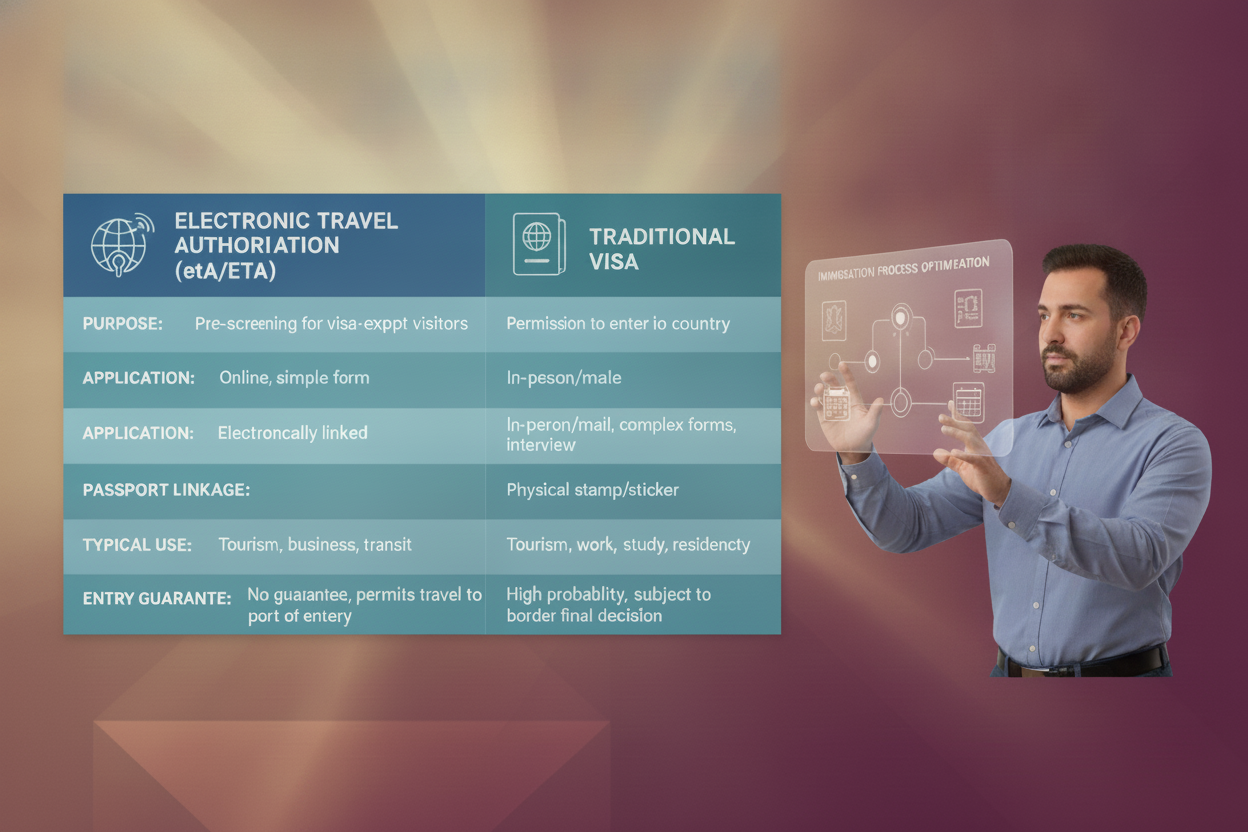
The takeaway is straightforward: an eTA or ETA may be lighter than a traditional visa process, but it still deserves the same level of care when you enter your details and plan your trip.
Why these approvals are harder to track now
The modern problem is not that eTAs are impossible to understand. It is that travel requirements are now fragmented across nationality rules, travel modes, transit points, and purpose-based conditions. Travellers are expected to piece these together themselves.
That is what makes 2026 travel planning feel more complicated. A person may be visa-exempt for the destination, need an ETA for air travel only, face separate rules for a transit country, and still need to carry proof connected to a return flight, accommodation, enrolment, or work authorization. None of these rules are necessarily hidden. They are simply spread across different systems.
The four variables that change the answer most often
When travellers ask, “Do I need an electronic travel authorization?” the answer usually depends on a combination of factors:
1. Nationality
2. The exact passport used for travel
3. Destination and transit route
4. Purpose and mode of travel
That is why advice from friends can fail so quickly. Two people on the same route may have completely different requirements because they hold different passports or are travelling for different reasons.
Why 2026 adds another layer of complexity
The phrase “as of 2026” matters because digital entry systems are still evolving. More travellers are aware of eTAs now, but awareness does not equal accuracy. Many people know the acronym yet still assume the rules are universal across countries. They are not. A country using the label ETA in 2026 may apply different eligibility logic, exemptions, travel-mode rules, or family requirements than another country using a nearly identical term.
A better way to think about travel readiness
Instead of asking, “Do travellers usually need an eTA?” ask this:
What does this country require from me, using this passport, on this route, for this specific trip purpose, in 2026?
That framing sounds slower, but it is more reliable than broad assumptions.
A fast pre-booking self-check
Before paying for flights, ask:
- Am I visa-exempt for this destination, or do I need a separate visa route?
- If I am visa-exempt, does the destination still require an eTA or ETA?
- Does the requirement apply only to air travel, or also to transit?
- Am I travelling with the same passport I intend to use for the application?
- Does my purpose fit a visitor or transit category, or does it point to a work or study route instead?
Who usually needs an electronic travel authorization
The most useful question is not “What does eTA stand for?” It is “Could my exact trip require one?” For travellers in 2026, that answer is increasingly tied to profile-specific details rather than broad country labels.
In general, electronic travel authorizations are often used for travellers who are eligible to travel without a full visitor visa, but who must still complete a pre-travel screening step. That means eTAs and ETAs often sit between two older categories: fully visa-free travel and traditional visa-required travel.
Traveller groups that should check especially carefully
The following profiles are more likely to run into avoidable mistakes if they assume too much:
- Visa-exempt tourists who think a passport alone is enough
- Short-notice business travellers booking close to departure
- Transit passengers who assume they need nothing because they are not leaving the airport
- International students who believe a study-related approval covers every travel step automatically
- Skilled workers who assume a work permit or job-related permission replaces travel authorization rules
- Dual nationals deciding which passport to use
- Recent passport renewers who may have an old approval connected to an expired document
- Families with mixed nationalities where each person may have different requirements
Why students and workers should be extra careful
Many migration-related travellers misunderstand where the eTA fits in the bigger document stack. A student may focus on an admission letter and study permit. A worker may focus on an employer process or work authorization. But airlines and border systems still care whether the traveller has the correct travel-linked permission for the passport being presented.
This is especially relevant for people who travel repeatedly between terms, jobs, or countries. The immigration route that defines your stay and the authorization that enables the trip itself are not always the same thing.
Families often discover the issue too late
One family booking does not create one legal profile. Each traveller is assessed individually. Parents may hold one nationality, children another. One person may need an ETA, another a visa, and another nothing additional. If one family member is missing the correct authorization, the practical impact can affect everyone.
The practical rule of thumb
If any of the following changed since your last trip, recheck your status before you assume an old answer still applies:
- your passport
- your nationality documentation
- your route
- your transit country
- your trip purpose
- the destination’s digital travel system in 2026
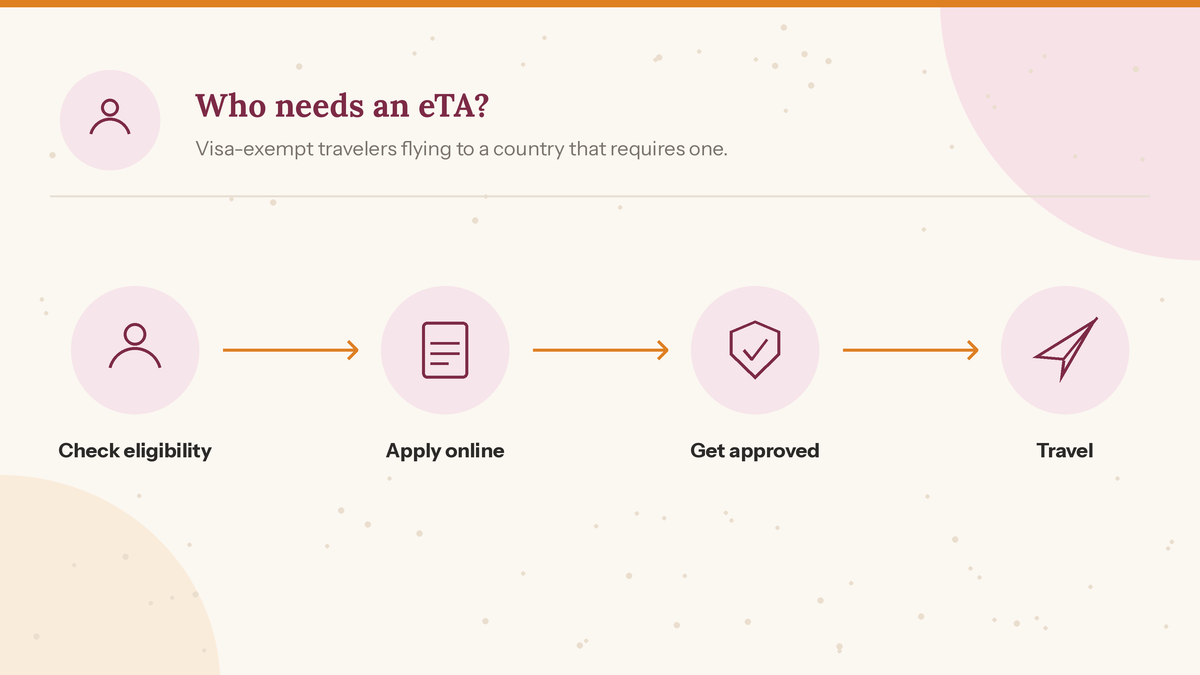
The safest mindset is not “people like me usually do not need this.” It is “I need to verify what applies to me on this exact trip.”
How the application process usually works from start to finish
Most electronic travel authorization systems follow a similar structure. You access the official application path, enter your identity and passport details, answer background questions, pay any fee that applies, and wait for the outcome or next steps. The process sounds simple because, in many cases, it is simpler than a full visa application. But simple does not mean low-risk.
The biggest practical mistake is treating the form casually because it is online and short. Travellers rush through it on a phone, let autofill insert old passport details, or submit late at night without checking every field. That is how small errors become boarding problems.
Typical application sequence
1. Identify the correct application route
2. Choose the correct passport or nationality category
3. Enter passport details exactly as shown
4. Add personal information and contact details
5. Answer any background or admissibility questions honestly
6. Review all fields carefully
7. Pay any required fee
8. Save the reference, receipt, or confirmation message
9. Travel with the same passport used in the application
What to prepare before you start
Set yourself up properly before opening the form:
- your current valid passport
- a reliable email address you can access during travel
- a payment method, if required
- enough uninterrupted time to review details carefully
- any trip details the form may request
The fields most likely to cause trouble
In many applications, the risky fields are the ordinary ones:
- full name exactly as printed in the passport
- passport number
- issue date
- expiry date
- date of birth
- nationality
A useful two-minute quality check
Before submitting, compare the form to the passport line by line. Do not just scan it visually. Put a finger on each passport field and verify it against the screen. This sounds basic, but it catches some of the most expensive mistakes in digital travel applications.
A sample “slow apply” checklist
| Step | What to do | Why it matters |
|---|---|---|
| 1 | Confirm you are on the correct application route | Prevents using the wrong system or service |
| 2 | Check the passport in your hand | Avoids applying under an old or alternate passport |
| 3 | Turn off autofill assumptions | Reduces hidden data errors |
| 4 | Enter details exactly as shown | Supports passport matching |
| 5 | Review before payment | Cheaper than fixing errors later |
| 6 | Save proof of submission | Helps if you need to check status later |
In 2026, the application itself may still be quick. The better goal is not speed. It is accuracy.
What an approved eTA does not do for you
One of the most common misunderstandings is assuming that an approved authorization means the trip is fully sorted. It does not. An eTA or ETA is one layer of travel compliance, not the entire legal basis for entry or stay.
Understanding that boundary matters because many travellers only discover the limits of their approval when they are already at the airport or facing questions on arrival.
It does not guarantee entry
An approved authorization may allow you to travel to the border, but border officers still assess whether you can enter under the relevant rules. They may ask about your trip purpose, your documents, your onward travel, or the consistency of your answers.
It does not replace visas, permits, or other immigration routes
If your plans involve more than a short visit, another immigration route may matter far more than the eTA itself. That can include:
- starting work
- beginning a course of study
- relocating for a longer period
- joining family under another category
- entering under a permit-based pathway
It does not automatically survive passport changes
Because the authorization is generally linked to the passport used in the application, a new passport can disrupt the setup. If you renew your passport, replace a lost passport, discover a data error, or decide to travel under another nationality, you need to recheck what happens before departure.
It does not override airline document checks
Airlines are part of the compliance chain. If your passport, route, and authorization do not line up correctly, the airline may deny boarding even if you believe your trip is legally valid in principle.
A simple mental model
Think of an eTA or ETA as a boarding-enabler for certain travellers, not a universal permission slip. It may unlock one gate in the journey, but not every gate.
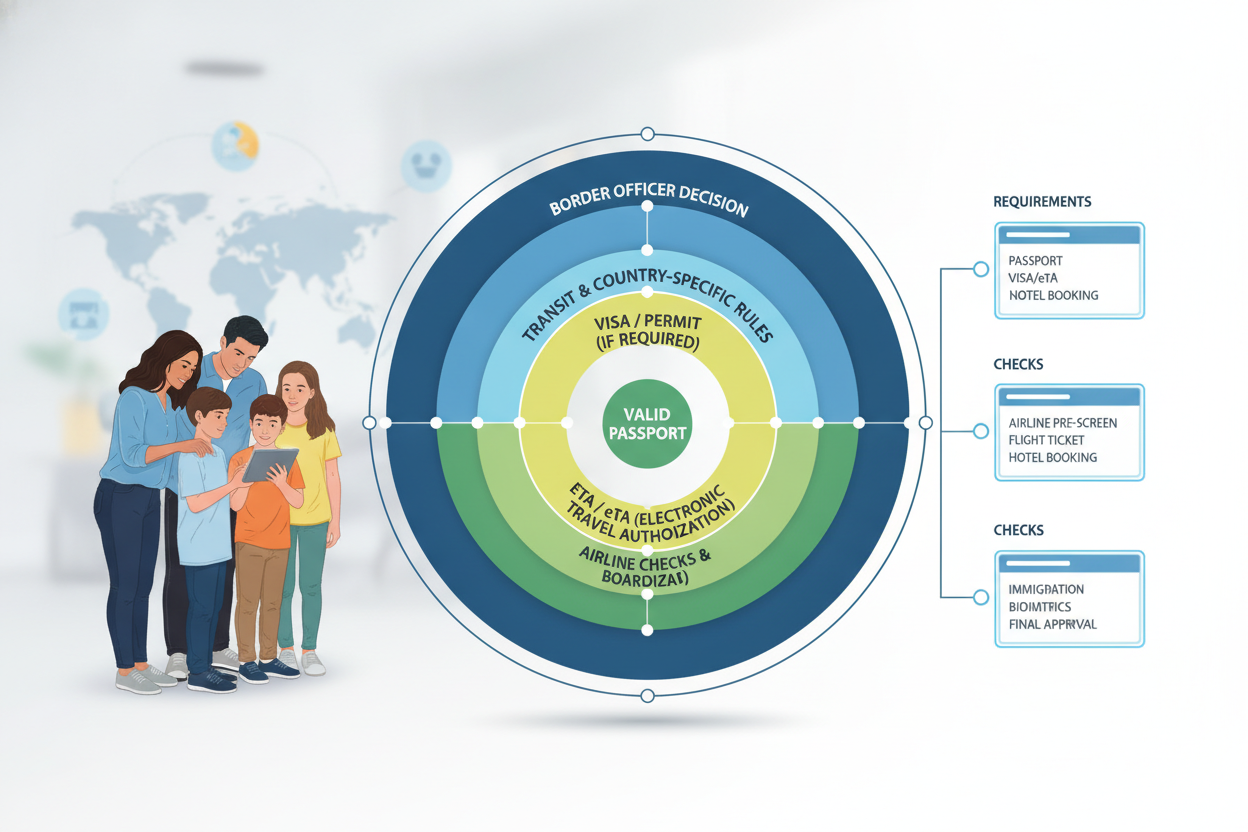
That mindset helps travellers avoid one of the most costly assumptions of all: “I have the approval, so I must be fully ready.”
The contrarian reality: the easiest-looking forms often create the costliest mistakes
Most people assume immigration problems come from complex visas, long evidence lists, and formal interviews. Sometimes they do. But in day-to-day travel, some of the costliest mistakes come from short digital forms that travellers do not respect enough.
That is the contrarian lesson of eTAs in 2026. Because the process often looks light, people behave casually. They apply too late. They trust autofill. They use the wrong passport. They rely on a summary article written for a different nationality. They book a transit-heavy route without checking whether every stop follows the same logic.
Five mistakes that cause avoidable disruption
1. Applying too late because “it’s online”
Digital does not always mean instant, and even a routine application can be delayed by follow-up checks, technical problems, or a simple typo that needs correcting. A short form submitted at the last minute leaves no room to solve anything.
2. Using the wrong passport
This affects:
- dual citizens
- frequent travellers with more than one passport
- recent passport renewers
- parents applying on behalf of children
3. Confusing “approved” with “fully prepared”
An approval can create false confidence. Travellers stop checking the rest of their document set because they think the main hurdle is finished. But the eTA may only be one piece of the travel puzzle.
4. Ignoring transit as a risk point
Many travellers still think, “I am only changing planes.” That assumption can be expensive. Transit is often where requirement mismatches surface.
A pre-submission risk checklist
Before you apply or fly, ask:
- Am I using the exact passport I will present for travel?
- Does any transit point add its own rule?
- Does my travel purpose fit this authorization type?
- Have I manually checked my data instead of trusting autofill?
- Am I leaving enough time to fix a problem if something is wrong?
A practical system to use before booking, applying, and flying
You do not need to memorize every ETA rule in the world. What you need is a repeatable system that keeps you from making preventable mistakes. Good travel preparation is less about knowing everything and more about checking the right things in the right order.
A simple three-stage routine works well for most travellers: before booking, before applying, and before flying. If you are a student, skilled worker, or frequent international traveller, this kind of process matters even more because your trip may involve more than one immigration layer.
Stage 1: before booking
Use this checklist first:
- verify the destination’s current entry rules for your passport in 2026
- check whether a transit country creates another requirement
- decide which passport you will use from start to finish
- confirm your trip purpose: tourism, business, study, work, family, or transit
- recheck assumptions if you travelled there before under different conditions
Stage 2: before applying
Follow a slow, clean sequence:
1. Put the correct passport beside you
2. Open the correct application route
3. Ignore saved autofill where possible
4. Complete the form carefully
5. Review all passport numbers and dates twice
6. Save confirmation details in one place
Stage 3: before flying
Do a final trip-readiness check:
- same passport used for the application
- authorization status confirmed where required
- any separate visa or permit documents ready if relevant
- itinerary and confirmation records accessible
- supporting documents available for the nature of your trip, where appropriate
One workflow table worth keeping
| Stage | What to verify | Common mistake avoided |
|---|---|---|
| Planning | Nationality, route, purpose | Booking the wrong type of trip setup |
| Booking | Destination and transit requirements | Paying for flights before checking rules |
| Application | Exact passport details | Passport mismatch |
| Pre-departure | Complete document set | Airport surprises |
| Airport day | Same passport and linked records | Failed check-in or boarding issues |
Where LiveMigrate fits
For travellers managing more than one country, family member, or immigration pathway, the hardest part is often not the form itself. It is keeping the whole picture straight. A practical platform can act as a clarity layer by helping you organize what to check, what has changed, and what still needs attention before a trip.
That is especially valuable for:
- international students travelling between terms
- skilled workers relocating or taking multi-country routes
- families with mixed nationalities
- frequent travellers who cannot afford last-minute document confusion
Final takeaway: treat eTAs as part of a bigger digital travel system
Electronic travel authorizations sit in a middle zone that travellers often underestimate. They are usually less demanding than full visas, but they can still determine whether you board at all. In 2026, that matters more because travel rules are increasingly digital, route-sensitive, and tied to the exact passport in your hand.
If you remember only a few points, keep these:
- an eTA or ETA is usually passport-linked
- it is country-specific, not universal
- it does not guarantee entry
- it may matter even for transit
- a passport mismatch can make an approval effectively useless
If your next journey involves an eTA, ETA, visa question, transit stop, or a move for study or work, use this article as a planning baseline — then verify your exact situation through the proper official route. And if you want a clearer way to track travel and immigration requirements across countries, use LiveMigrate to organize the details before one small missing approval disrupts a much bigger plan.
FAQ: common electronic travel authorization questions
Is an electronic travel authorization the same as a visa?
No. It is usually a lighter digital pre-travel approval for eligible travellers, while a visa is a separate and often more detailed immigration permission.
Does an approved eTA or ETA guarantee entry?
No. It may allow you to travel, but a border officer still decides whether you can enter on arrival.
Do I need an eTA if I am only transiting?
Possibly. Transit rules vary by country and route, so never assume that staying in the airport means no authorization is needed.
What if I renew my passport after approval?
Recheck the rule before travelling. Because the authorization is often passport-linked, a new passport may change whether the existing approval is still usable.
Canada eTA
Ready to travel to Canada?
Apply for your Canada Electronic Travel Authorization online. Quick, guided, and approved in minutes.